

When you buy a generator, ask about the specifications of its silencer and the noise level of the generator, as well as the emissions of polluting gases it produces.
With FG Wilson, this is clear:
All Level 1, Level 2 and Level 3 enclosures reduce noise levels to comply with Stage II of EU Directive 2000/14/EC, in force from 3 January 2006. Source : FG Wilson
As an option, you can choose :
- Industrial silencer (10 dBA reduction)
- Residential silencer (25 dBA reduction)
For single-phase generating sets from 7.5 to 16.5 kVA, here are the noise levels measured. These tables are available for all FG Wilson power ratings.

Acoustic tests are carried out at the factory in a hemi-anechoic room (see video below).

Emissions tests are carried out by the engine supplier, Perkins.
"Our 400 Series is a proven family of motors designed to offer optimised performance and robust technology for the smaller, compact motor sector. Our industrial motors in the series are a global engine, manufactured on three continents. They are designed to meet global emissions standards, from non-regulated to European Stage IIIB / U.S. EPA Tier 4 Final. The electric motors in the series meet both regulated and non-regulated emission standards globally." Source : Perkins
In the world of generators, a silencer performs the same function for combustion engines as a muffler does for engines in automotive and construction applications. Both reduce noise and exhaust emissions produced during combustion. Source : https://www.generatorsource.com/Generator-Silencers.aspx
There are three basic silencer designs:
- Reactive muffler - The internal construction comprises up to three chambers connected by a tube. Exhaust noise bounces between the chambers, reducing output noise. Used to reduce noise from low to medium frequencies.
- Absorbent silencer - The internal construction consists of fibreglass or glass insulation. Exhaust noise is attenuated as it passes through the insulation. This method is used to reduce high-frequency sound waves.
- Combination silencer - As suggested, combines the construction of reactive and absorptive silencers. The absorption material is integrated into the chamber design of the reactive silencer. This allows the reduction of all frequency designs.


The different qualities of silencers on the market are :
Industrial quality - Exhaust noise reduced by 15 to 20 dBA
Residential quality - Exhaust noise reduction 20 to 25 dBA
Critical grade - Exhaust noise reduced by 25 to 32 dBA
Super Critical Grade - Exhaust noise reduction from 30 to 38 dBA
Hospital quality - Exhaust noise reduced by 35 to 42 dBA
Hospital Plus Grade - Exhaust noise reduced by 35 to 50 dBA
Extreme Grade - Exhaust noise reduced by 40 to 55 dBA
Super Extreme Grade - Exhaust noise reduced by 45 to 60 dBA
Cylindrical silencers
Cylindrical silencers were among the first forms developed. They can be built in three basic designs and used for both indoor and outdoor applications. The silencer can be mounted horizontally or vertically to meet all application requirements. It is considered to be one of the most economical silencers available.
Low profile silencer
These silencers come in a variety of shapes, including rectangular, oval and round. The shape chosen is determined by the space available. They are commonly used in generators located in soundproof enclosures. Silencers must comply with National Fire Protection Association (NFPA) guidelines.
When a generator operates in a combustible environment, modifications must be made to the exhaust system to ensure that sparks generated during the combustion process are not emitted into the outside atmosphere. Spark arresting silencers are generally cylindrical in shape and have a modified reactor design. This allows carbon sparks to circulate through the silencer by falling into a collection box. The collection box should be cleaned as part of the maintenance programme.
Exhaust gases can reach temperatures of up to 1400 degrees Fahrenheit. These gases are often released into the atmosphere. Heat recovery silencers are used to utilise the heat in the exhaust gases before they are released into the atmosphere. This heat supply can be used for any system requiring an external heat supply (heated water).
Emission control silencer
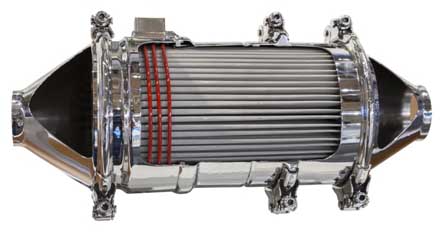
Combustion gases are made up of many different gases. Some gases are extremely harmful, others less so. The Environmental Protection Agency (EPA) applies exhaust gas regulations to reduce harmful exhaust gas emissions.
The EPA tightly regulates emissions from generators that supply a facility with primary electricity. Current Tier IV regulations require the use of a catalytic converter. The basic converter consists of a honeycomb grid design that is placed in the exhaust system directly after the exhaust manifold. This location allows the exhaust gases to be at the maximum temperature necessary for proper operation. Many new silencers combine the converter design with the silencer.
The particulate content of exhaust gases is also addressed in Tier IV regulations. Particulate filters can be used to reduce the soot content of exhaust gases. The inside of the filter is made of ceramic. The exhaust gases pass over the material and the soot is collected. Lean burn engines can also use an additive to further reduce harmful emissions.
Source : https://www.generatorsource.com/Generator-Silencers.aspx
In the DRC, for the time being, in 2021, there are no emission standards for generating sets. Most imported sets therefore emit as many particles as possible (they are "fuel optimised"), unless requested by the customer.
To find out more or get a quote for an FG Wilson generator set, contact us.

Unicompex Congo
Emergency power since 1997
By email : contact@unicompex.net or by telephone: +243 81 99 35 000
Address: 1458 Avenue Colonel Lukusa, Gombe, Kinshasa, Democratic Republic of Congo
 English
  French
  Spanish
  Chinese
  Hindi
Hindi