


Our history is linked to that of our founders, Sultan and his son Karim Noorani. Both have lived in the Democratic Republic of Congo since the 1950s. Unicompex exists thanks to their efforts and we continue to work with their vision.
Sultan Noorani, founder
Since the 1950s, Sultanali Noorani has launched numerous businesses in the Democratic Republic of Congo. He has had many businesses and jobs in his lifetime. Here are some of the most memorable ones he built.
In the 1950s, he had a retail shop and semi-entire beer sale, a curio shop with products from Hong Kong, Thailand and Lebanon (the shop was opposite the Memling Hotel) in Léopoldville, Kinshasa.
His younger sister, Zarina, then aged 16, ran the shop between 1956 and 1959.
In 1961, during the civil unrest when many shops and businesses were closed, he worked for the United Nations in Kinshasa and Bukavu for 6 months.
In June 1961, he went to Mbuji-Mayi. He opened a shop selling products from Kinshasa. Textiles were the best-selling items.
Sultan eventually opened other shops in Kananga and Lubumbashi.
He opened a bakery and patisserie in Kananga (1963-1974) using machinery imported from Greece. This bakery was run by his brother Sadru. The bakery was eventually moved to 4th rue Limete.
He also launched Trabet, a river sand extraction service for the construction industry. It operated from 1965 to 1974. In 1974, it finally closed due to nationalisation by the government.
There was also Sopal, which reconstituted milk and ice cream (the factory was at Limite 4eme rue Kinshasa).
- He had bought a Swiss machine to make the milk.
- He installed a huge Tetrapak machine to process the milk.
- Finally, long-life milk in cones was imported, which meant that Sopal milk was no longer in demand.
- Sultan went on to manufacture dairy products such as cream cheese, yoghurt and ice cream, which proved very popular with supermarkets and restaurants.
- In 1973, he introduced ice creams sold by an army of bicycle vendors all around the city. His daughter Gulshan (16) created the illustration of the smiling face.
- Sultan and his two brothers Badhur and Sadru decided to divide up all the businesses and Badhur took over Trabet which proved to be very profitable, Sadru took over the bakery and a shop in town and Sultan was left with Sopal.
In 1974, following the exodus of Asians from Uganda, the government of Zaire - principally President Mobutu Sese Seko - began to nationalise many non-Zairian-owned companies.
As a result, many Asians have left their businesses and homes to emigrate to Canada and Europe.
Since Sultan was President of the Ismaili Council and was responsible for at least 1,000 Ismaili families during this period of crisis, he was obliged to close Sopal and spend much of his time helping families with their Canadian immigration papers.
It was a full-time job because the families arrived in Kinshasa from the interior without accommodation or money.
In 1975, when the exodus of Asians had a detrimental effect on the Zairean (Congolese) economy, the rules were relaxed and Sultan was able to re-establish his business.
Sultan and his various partners eventually built the following businesses:
- Sopal : Manufacture of reconstituted milk and ice cream in Kinshasa
- Trabet: River sand dredging
- Isombe: Exclusive Honda dealer in Zaire selling motorbikes, cars and emergency generators with his son Karim Noorani. Also owned by Jacques Isombe, his former business partner.
- Melotte: Belgian industrial supplier of agricultural equipment in the DRC, including small motorised mills and tractors. Also owned by André Schetter, his former partner.
- Unicompex Congo: Sale and maintenance of generating sets managed and assembled by his son Karim Noorani
Privacy policy
Hobbies and passions
Sultan was an avid reader who never stopped learning.
He loved sport and always tried to be as healthy as possible.
He was a lover of wisdom and cared deeply for his employees, family and friends.
He devoted much of his time to the Ismaili community and its faith.
He loved to travel and had visited many countries.
He was a fighter and always did his best to charm his customers and negotiate the best prices. He was a tough businessman who rarely gave up.
He was a hard worker who was never lazy.
He loved golf, cycling and card games: rummy and bridge in particular.
He enjoyed discussing and reading about geopolitics all his life.
He spoke 10 languages: Kingogo, Swahili, Lingala, Urdu, Gujurati, Hindi, English, French, Portuguese and Tshiluba.
He has lived in every corner of the Democratic Republic of Congo: from Kinshasa to Mbuji-Mayi, via Goma and Lubumbashi.
Wedding
Sultan married Dolatkhanu Kassam in December 1954, with whom he had 3 children.
In July 1960, during the Congolese civil war, all the women and children had to leave the Congo, so Dolatkhanu left with her 2 youngest children Gulshan and Karim for London, in the United Kingdom.
His eldest son Zahir arrived 6 months later.
- Zahir Sultan (b. 1955-d. 2011) who had a son with Corinne Evens, Jonathan Zahir Evens (b. 1990)
- Gulshan (born 1957)
- Karim (born 1958), who married Aracelli Espinoza Noorani in 1984. They have 4 children: Emilio (born 1987), Aysha (born 1989), Rodrigo (born 1997) and Alejandro (born 2003-d. 2004)
Dolatkhanu and Sultan divorced shortly after giving birth to their last child Karim. Dolatkhanu remarried Abdul Pirbhai Kassam.
In 1965, Sultan married Kathoon Karmali, who was also divorced with a young son named Feroz (8), and together they had a son named Mahmood in 1967.
- Feroz Karmali (born 1957) and has three children: Omar, Miriam from his first marriage and Tiger from his second marriage.
- Mahmood (born 1967), who lives in the UK with his wife Camilla. They have three sons: Alexander, Victor and Odin.
Sultan passed away in September 2019 in the UK at the age of 89.
1930s - The beginnings
Sultan Ali Hasham Lalji Noorani was born in Nyeri, Kenya on 27 October 1930. He was the son of Mr Hasham Lalji Virsam and Rehmat Bhai Jamal Daya Velani, originally from Bhanvad, Kathiawar, Gujarat.

1940s - Childhood
In 1940, 10-year-old Sultanali moved to Dar-Es-Salaam, Tanzania, to begin his education. He later graduated in Bujumbura, Burundi.
1950s - Moving to Zaire
In 1954, Sultan travelled to the Belgian Congo with his brothers Badhrudin and Sadrudin, in search of new opportunities. He married Dolatkhanu Amersi Kanji at the age of 24 and lived together in Basoko Street. From 1955 to 1958, they moved to École Street where their three children grew up: Zahir, the eldest, Gulshan and Karim, the youngest. In 1956, Sultan opened his own shop and began trading in general merchandise on Hospital Street.
1960 - Independence of the Congo
The Belgian Congo gained independence on 30 June 1960. In July 1961, a revolution forced the family to leave the country.
Sultan then started going to Mbuji-Mayi with his old friend Amin Janmohammed and Jaffer, who were Ismailis like him. They started trading goods such as cigarettes and beer.
In 1965, Sultan remarried Kathoon Karmali on 10 September 1965. They raised their two additional sons, Firoz and Mahmood. Zahir, Gulshan and Karim also grew up in Kinshasa. They all attended TASOK, the American school in Kinshasa.
1970s - Sopal
In 1970, Sultan founded Sopal an ice cream factory, a dream he had had since childhood. He bought the first Tetra Pak machine in the DRC and employed more than 100 resellers.
He then set up an import-export company with his Congolese partner Jacques Isombe during the Zairianisation.
He travelled to many countries, but mainly to Brazil, China and Japan. In Japan, he met car manufacturer Honda and agreed to become their sole distributor in Zaire. Zahir, his eldest son, eventually joined the company for a short period after his studies in the United States.
1980s - Honda
In 1980, his youngest son, Karim, after obtaining his bachelor's degree in mechanical engineering in Canada from Concordia University, joined the family business at the age of 24.
Together, father and son, they developed the business and opened the first Honda garage on 4th Street in Limete, Kinshasa.
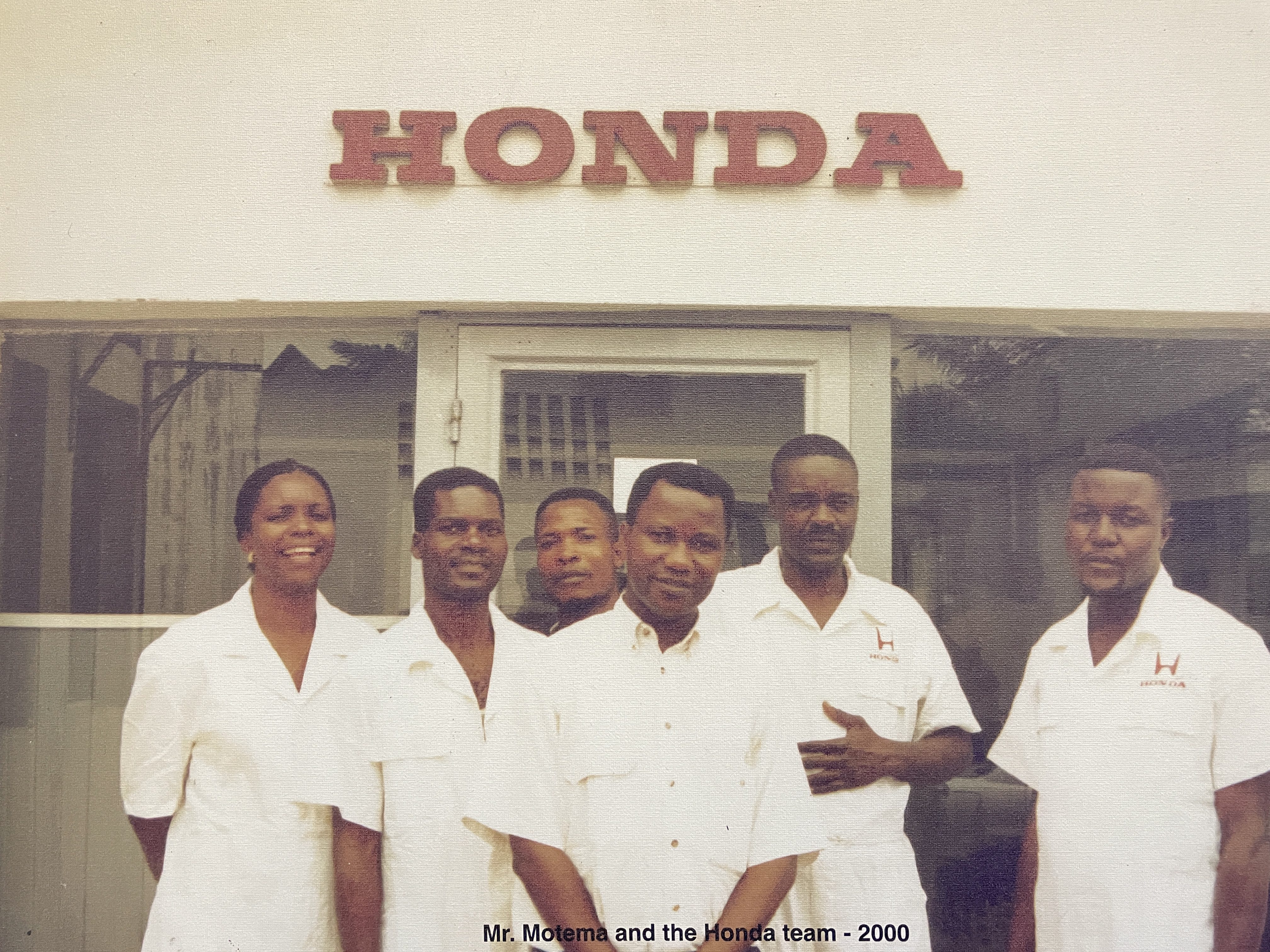
Manager Léon Motema Malemo went to Japan and returned to the company, helping to grow and build the garage. He stayed with the company until today (2021), when he is now head of Unicompex's telecoms maintenance department.
1990s - Honda
In 1990 and 1991, Isombe, Sultan and Karim's Honda products business was hit hard by looting in Kinshasa. They lost millions of dollars worth of goods after their homes and offices were emptied by demonstrators. They fled Zaire to Congo Brazzaville for 2 years to rebuild the company.
Eventually, things settled down and after paying off huge debts to suppliers and taking out loans from friends and family, the business grew again. Karim had secured a contract to manage the Shell Oil Company service stations in Kinshasa, where he continued to sell Honda products such as motorbikes, cars and small portable generators.
However, in 1997, the then president of Zaire, Mobutu, was overthrown by Laurent-Désiré Kabila's AFDL. Honda Isombe had to be closed down and the entire Noorani family moved to the UK and South Africa.
But Karim, Sultan's partner and son, kept returning to Zaire, now the Democratic Republic of Congo, to rebuild his business.
On 19 July 1997, Karim and his father Sultan set up Unicompex from scratch.
They began to introduce the sale and servicing of diesel generators by FG Wilson, Lister Petter, Deutz and Perkins. They began servicing diesel generators for telecoms operators Vodacom and Celtel.
2000s - FG Wilson
In 2001, Unicompex became the exclusive FG Wilson dealer in the DRC. FG Wilson is a company with over 50 years' experience in the manufacture of diesel generators. They are a British company and part of the Caterpillar group.
2010 - Telecoms
In 2010, Unicompex developed significant projects with Vodacom in Kinshasa, maintaining more than 600 base transceiver station sites equipped with 20 kVA diesel generators.
Unicompex now represents the following suppliers:
- FG Wilson, a 50-year-old British manufacturer of diesel generator sets, owned by Caterpillar since 1999
- Datakom, a Turkish company specialising in control panels with remote monitoring and synchronisation
- Inforise, static voltage regulation company in Turkey
- Deutz, a German engine company
In 2018
- Unicompex has won a contract to maintain 400 telecoms sites for Helios Towers Infraco in the east of the DRC: Goma, Kisangani, Bukavu, Bunia, Beni, etc. This is a region known for its instability and difficult working conditions. Part of the project took place during the Ebola epidemic and the conflicts.
In 2019
- Unicompex began distributing and selling its own brand of "Unicoil" lubricants for all kinds of engine applications.
- Opening of a branch in the Republic of Congo, Brazzaville.
Today, Unicompex employs more than 150 people in Kinshasa, Lubumbashi, Goma and other major cities in the DRC. They are committed to their customers and employees in order to be a leader in the emergency energy sector in the Democratic Republic of Congo for years to come.
Photographs
1970s - Marche Ouvrière MPR

1980s - Fikin
"The Foire Internationale de Kinshasa (FIKIN) was an international event of a commercial, industrial, agricultural and craft nature, located in the commune of Limete (main entrance opposite Lemba) in Kinshasa in the Democratic Republic of Congo.
FIKIN is also the venue for this biennial event. Every odd-numbered year, in July, FIKIN welcomes international participants. In even-numbered years, a national meeting is held here.
The first international event was held from 30 June to 14 July 1969. Several other international events have been held there.
In 1991 and again in 1993, the national edition of FIKIN was looted in Kinshasa. Since the looting, the festival has run at a slower pace. During the summer, it hosts one of Africa's biggest music festivals.
Isombe took part in this event in 1985. Here are a few photos of the event.
FIKIN Kinshasa Fair 1985


Honda Training Centre

Journey to Japan in the 1980s
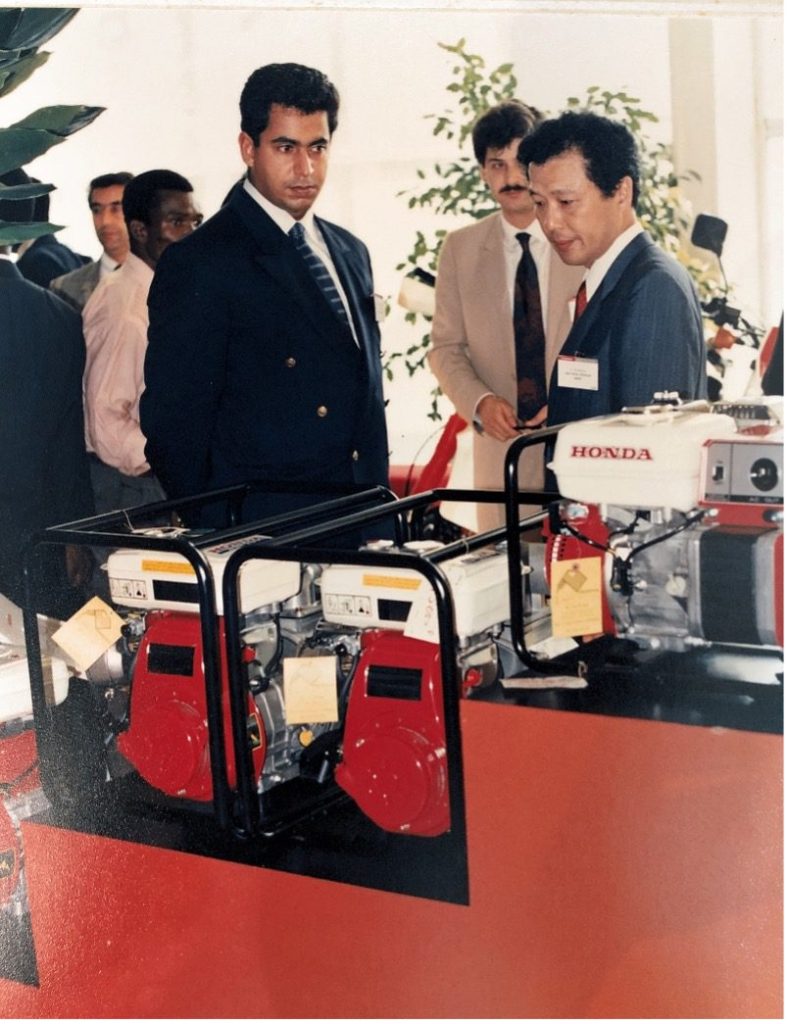

Honda Africa Dealer Meeting April 1990


Isombe Honda Team
Before Unicompex, Karim and Sultan had founded Isombe Honda. This was a company selling and servicing Honda products. Together with Léon Motema, the administrative manager, they imported, sold and serviced motorbikes, cars and generators.

Melotte
In the 1980s, Sultan Noorani became a shareholder in Melotte Congo, an agricultural company. It was not until 2003 that Unicompex moved from Limete to the former offices of Melotte, which was virtually unviable at the time.
The 1960s and 1970s
Melotte's primary vocation was the import, manufacture and distribution of agricultural equipment, in particular milk skimmers, maize and manioc mills, rice huskers, maize and groundnut huskers, nut grinders, palm oil grinders, etc.
Melotte has also taken on the import, distribution and maintenance of:
- Earthmoving equipment; graders, backhoe loaders Hanomag (Germany)
- Public works equipment, concrete mixers, water pumps, dumpers, lifts Richier (France)
- Pumping equipment (hydrophore units, Delaule France pumps, water pumps and galvanised tanks Herstal / Belgium
- Funki hatcheries (Denmark)
- Brenta-Danckart sawmill machinery
- Lurem and Quilliet woodworking machines (France)
- Bernard petrol and diesel engines (France)
- EXIMO / Belgium welding equipment (welding electrodes, welding gates, etc.)
- Baudouin marine engines (France)


Unicompex in 2003
Sultan and Karim set up their new company Unicompex, specialising in the maintenance of generators for the telecoms industry, with customers including Vodacom, Celtel and Tigo.
Unicompex became the official representative for FG Wilson generator sets in 2001.
Photos of the Melotte Congo installations on Lukusa in 2003


Photos of yesterday and today: Unicompex / Melotte Congo in August 2003 and Unicompex in November 2020, 17 years later


Unicompex today


Acknowledgements
This page and the information shared has been compiled with the help of Gulshan Noorani, the Sultan's daughter, Karim Noorani, Aracelli Noorani, Motema Malemo, Edouard Ntona and all the family, employees and friends who have kept records (texts, documents, photographs) since the 1950s.
We thank them all on behalf of Unicompex and its employees. They are grateful for all their hard work and efforts over the years and for their future endeavours.
If there are any inaccuracies, comments or any other information you would like to add, please write to contact@unicompex.net and kenoorani@unicompex.net.
This document is subject to change or correction and is a subjective account of events from a variety of sources. We apologise for any errors or corrections.
 English
  French
  Spanish
  Chinese
  Hindi
Hindi