
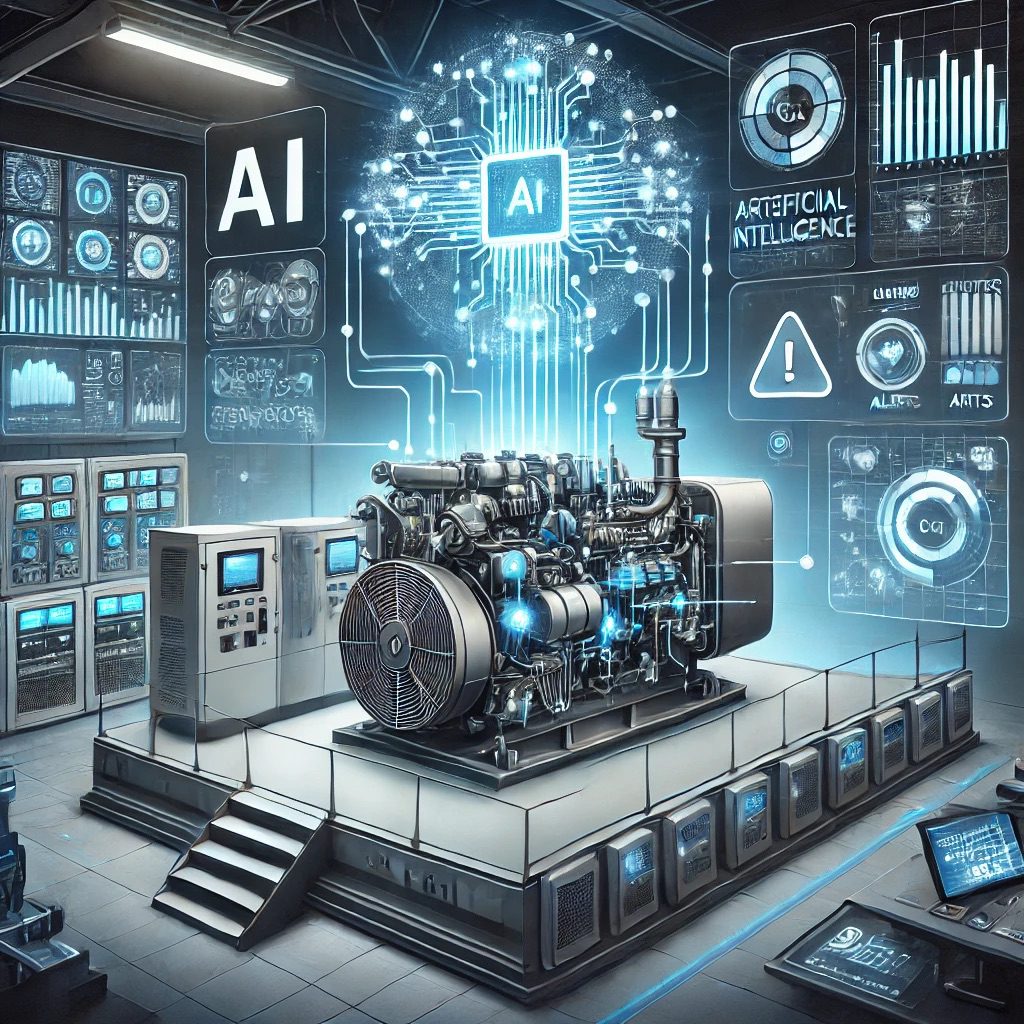
Artificial intelligence (AI) can play a crucial role in generator maintenance and troubleshooting by providing more efficient, accurate and proactive solutions. Here's how AI can help in these areas:
1. Predictive maintenance
- Real-time data analysis : AI can continuously monitor data from sensors installed on generator sets, such as temperature, vibration, fluid levels and emissions. By analysing this data in real time, AI can detect anomalies or trends that precede a breakdown.
- Fault prediction : Based on historical operating data, AI can predict when certain parts of the generator set are likely to fail, enabling preventive repairs to be carried out before the problem occurs.
2. Optimising maintenance intervals
- Dynamic planning : AI can adjust maintenance schedules according to actual usage and operating conditions of the gensets, rather than following a fixed schedule. This minimises downtime and optimises maintenance costs.
- Component condition assessment : Thanks to machine learning, AI can assess wear and tear on individual components and recommend replacement only when necessary, thus avoiding premature replacement.
3. Breakdown assistance
- Automated diagnostics : In the event of a malfunction, the AI can analyse the symptoms reported by the sensors and compare the data with a knowledge base of past failures to quickly identify the likely cause of the problem.
- Repair recommendations : AI can provide specific recommendations for resolving identified problems, including repair steps or parts to be replaced, based on proven procedures and technical manuals.
4. Remote monitoring and centralised management
- Remote monitoring : AI-based systems can monitor multiple generators at different sites from a single central platform. This makes it possible to manage the entire fleet of generators more efficiently and respond quickly to any problems at a remote site.
- Proactive alerts : AI can send real-time notifications to technicians when an anomaly is detected, even before it causes a breakdown, enabling rapid intervention.
5. Improving energy efficiency
- Optimising performance : AI can automatically adjust generator operating parameters to maximise energy efficiency, taking into account load conditions and the environment.
- Lower fuel costs : By optimising fuel use and reducing unnecessary running times, AI helps to reduce the operating costs of gensets.
6. Augmented reality (AR) training and support
- Interactive guides : Thanks to AR combined with AI, technicians can receive real-time visual instructions on how to carry out complex repairs or maintenance, by superimposing the information directly onto the equipment.
- Remote technical support : In the event of complex troubleshooting, AI can assist technicians in real time, suggesting steps to follow or connecting the user to an expert for direct assistance via an AR interface.
7. Intelligent documentation
- Automated document management : AI can organise, search and deliver relevant technical documents according to maintenance or troubleshooting needs, facilitating rapid access to critical information.
- Automatic updates : AI can ensure that the documentation used by technicians is always up to date, by automatically integrating new information or procedures.
By integrating AI into generator maintenance and troubleshooting processes, companies can improve equipment reliability, reduce downtime, and optimise operational costs while increasing the efficiency of maintenance teams.
That was ChatGPT's response 🙂
What do you think?
 English
  French
  Spanish
  Chinese
  Hindi
Hindi