
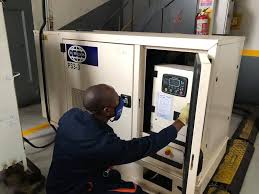

Here is an extract from the generator set user manual and the manufacturer's recommendations for the correct and long-lasting use of your FG Wilson generator set.

Pre-start checks (applicable to all control systems)
Warning: The checks detailed below are the only tasks that can be carried out by an operator.
The following checks should be carried out before starting the generating set:
- A simple visual inspection should only take a few minutes and can prevent accidents and injuries.
more costly repairs. - To ensure the generator lasts as long as possible, inspect it visually before starting it up.
Check the following points, among others:
- Fasteners loose, worn belts, loose fittings. Repair as necessary.
- The fan guards and exhaust must be in place and properly secured. Repair damaged/loose guards or replace missing ones.
- Clean by wiping every caps from filling before any maintenance work on the engine or topping up with ingredients, to reduce the risk of contamination of the circuits.
- Whatever the type of leak (coolant, lubricating oil or fuel), clean up any traces of liquid.
- If a leak is detected, find the source and fix it. If a leak is suspected, check levels frequently until the leak is found and repaired.
- All accumulation of grease and/or oil on an engine is a serious risk. risk fire. Clean with steam or a high-pressure cleaner. Keep the high-pressure cleaner away from electrical electronic equipment and provide suitable protection wherever possible.
- Make sure the coolant pipes are fitted. properly and well tight. Check for leaks. Check the condition of all ducts (and signs of rubbing).
Liquid levels
Check engine oil and coolant levels - top up if necessary (see engine manual for locations). Ensure that the ingredients used comply with the recommendations given in the engine manual.
Warning
Do not remove the radiator cap or any other part of the cooling system while the engine is running and the coolant is under pressure, as this could result in a dangerous gush of hot coolant, which could cause injury. Do not add a large quantity of cold coolant while the system is hot, as this could cause serious damage to the engine.
Note
Diesel engines normally consume lubricating oil at a rate of 0.25 % to 1 % of fuel consumption. When filling the fuel tank, do not smoke or use open flames in the vicinity. Always fill the tank when the engine is cold.
Warning
When filling the fuel tank, do not smoke or use naked flames in the vicinity.
Warning
Before tensioning the fan belts, disconnect the negative (-) battery cable to ensure that
to prevent the engine from starting accidentally.
Controls
- Check the condition and tensioning the engine fan and alternator belts - retighten if necessary.
- Check the mechanical condition and tightness of all the hoses - Tighten or replace as necessary.
- Check that the battery terminals are not corroded - clean as required.
- Warning :
When working with batteries, do not smoke or use open flames in the vicinity. Hydrogen gas from batteries is explosive. - Do not short-circuit positive and negative terminals together.
- Check the battery electrolyte level - top up with distilled water if necessary.
- Check the control box and generator set for dust and dirt build-up - clean if necessary. This build-up may present an electrical hazard or cause cooling problems.
- Check theair filter clogging indicatorReplace the filter if necessary.
- Clear the area around the generating set of any hazards that could prevent it from operating properly.
Check that the ventilation grilles are not obstructed. Check that the ventilation grilles are not obstructed. - Carry out a visual check of the entire generating set to detect any signs of leaks fuel system, cooling system or lubrication seals.
- Drain the steam traps periodically. condensate exhaust system, where applicable.
- If a liquid collection container is built into the chassis, it must be inspected. Any liquid (fuel, oil, coolant, rainwater or condensation) must be drained and disposed of in accordance with local regulations and mandates.
- Make sure the alternator output circuit breaker is in the "OFF" position (handle down).
GENERATOR MAINTENANCE
Warning :
The following procedures should only be carried out by a qualified technician.
- An effective and regular maintenance programme will ensure a long service life for the generating set.
- This maintenance must only be carried out by qualified technicians.
- Keep the maintenance reports, as they will make future work easier.
- In general, keep the group in a good state of cleanliness.
- Eliminate all deposits of fuel, oil or other products inside or outside the unit, as well as on or near the sound insulators.
- Clean surfaces with an aqueous industrial cleaner.
- Do not use flammable solvents for cleaning.
- Any acoustic insulation with a protective coating that is worn or perforated must be replaced immediately to prevent oil or other products from accumulating in it.
- Contact a qualified technician for details of preventive maintenance.
Battery maintenance
- Warnings
- Ensure that staff have been trained in the proper handling and use of batteries. Always wear the appropriate personal protective equipment (PPE) when handling batteries.
- You should also carry out maintenance checks on the batteries as part of your routine maintenance inspections.
- Always wear the appropriate PPE when handling electrolyte. If you are splashed with electrolyte, immediately rinse the affected area with fresh water and seek medical advice.
- Never add undiluted sulphuric acid to a battery.
- Keep batteries upright to avoid electrolyte spillage. The electrolyte is dilute sulphuric acid, which is harmful to the skin.
- Use tools with insulated handles when removing or installing batteries. Never connect battery terminals with metal tools or objects.
- During charging, the battery gives off explosive gases. Keep the battery in a well-ventilated area away from naked flames and sparks. It is also forbidden to smoke near batteries.
- By law, generator batteries must not be disposed of with household waste.
Batteries contain hazardous materials and in the charged state, each cell contains lead (Pb) electrodes and lead (IV) dioxide (PbO2) immersed in a sulphuric acid electrolyte (H2SO4) at 33.5 % m/m (6 molar) In the discharged state, the two electrodes form lead (II) sulphate (PbSO4) and the electrolyte releases sulphuric acid dissolved in primary water..
Disposing of batteries on landfill sites is therefore harmful to the environment, and burning batteries gives off polluting fumes.
Acid and lead batteries can be dangerous to handle, so it's vital to follow all the safety instructions.
Batteries are an essential part of the generating set and must be properly maintained. Keep the battery installation area clean and dry, and ensure that any cap vents are tight (if fitted).
Clean the battery case with one of the following cleaning solutions:
- A mixture of 0.1 kg (0.2 lb) baking soda and 1 L (1 qt) fresh water
- A mixture of 0.1 L (0.11 qt) of ammonia and 1 L (1 qt) of fresh water
Rinse the battery case thoroughly with fresh water.
All battery connectors must be clean and tight. Use fine-grit sandpaper to clean the terminals and cable fasteners. Clean until the surfaces are shiny. Don't remove too much material.
Excessive material removal can result in a poor connection between the fasteners and the battery terminals.
Apply grease or another terminal protection agent to fixings and terminals to prevent corrosion.
The electrolyte level should cover the plates/grids (13 mm / 1/2 inch) inside the battery to maximise transfer at full charge. If the liquid level is below the plates/grids, add only distilled water; never add battery acid to top up, as this will destroy the grids.
We recommend checking the electrolyte and condition of the batteries every 500 hours of operation.
If the ambient temperature is high, we recommend using temperature compensation and checking the electrolyte levels more often, e.g. tevery 200 hours of operation. These checks should also be carried out as part of your routine maintenance inspections.
Removing and fitting the battery
Battery acid can burn clothes and skin, or cause blindness if it leaks. Please wear protective clothing when inspecting a battery before disconnecting/transporting it.
- Make sure that the battery to be installed is filled to the correct levels with the correct electrolyte mixes and is fully charged.
- If vents are fitted, make sure they are held firmly in place.
- Before removing a battery, carefully check its condition. If visibility is poor, use a torch to check all sides of the battery for marks, impact marks or leaks.
- If the battery shows signs of impact or leaks, please contact your local distributor for assistance.
- DO NOT try to remove the battery.
- Disconnect the battery safely before inspecting it (see below).
- Disconnect any battery charging circuit before inserting the battery.
- When removing a battery for any reason, always make sure it is no longer under charge before disconnecting it, to avoid sparks. First disconnect the negative cable, then the positive cable, to avoid short-circuiting with a metal element, then remove the clamp or strap holding the battery to the base. As the battery can be heavy, please take care when lifting and carrying it. Ask for help if necessary.
- When you replace the battery, make sure that the terminals are correctly assigned to the cables to avoid any incorrect connections, place the new battery in the battery holder and secure it again using the clamp or retaining strap. First connect and tighten the positive battery cable to the positive terminal. Then connect and tighten the negative cable to the negative terminal.
- Keep the battery terminals clean and free from corrosion, and spread a little Vaseline on the connectors.
- Make sure the battery terminals are tight, as loose terminals can shorten the life of the battery and pose a fire hazard.
- Make sure that the positive terminal of each battery is correctly covered.
- When fitting a battery and/or battery charger, please ensure that they are suitable.
- If in doubt, consult a qualified technician.
- During transport, please ensure that the battery terminals are covered to eliminate any possibility of short-circuiting.
- Make sure that the battery is always upright.
Battery fluid levels
If your battery is leaking fluid or has a cracked casing, please consult your local distributor.
to have the battery replaced.
To ensure that the battery is operating at its optimum level, we recommend checking the fluid levels
in accordance with Section 9.1 of the manual.
Low fluid levels
The electrolyte level is too low if any part of the plates is exposed to the air. If the plates are not completely covered with electrolyte, the battery cannot operate at full capacity. Exposure of the plates to air can destroy the exposed area within a few days, reducing the performance of your battery. If the electrolyte is only about 13 mm (1/2 inch) below the plates, adding distilled water to the battery may restore it to service with a slightly reduced capacity. Please consult your local distributor about battery performance and replacement.
Recommended fluid levels
The recommended electrolyte level is about 13 mm (1/2 inch) above the plates or about 3 mm (1/8 inch) below the bottom of the filler tubes that run down from the openings. If the fluid level is within these recommendations, replace the port caps and recheck after three months.
Maximum fluid levels
The maximum fluid level for safety is reached when the fluid just touches the bottom of the filler tubes that come down from the port openings. When the fluid level reaches the bottom of a filler tube, an easily recognisable eye-shaped meniscus should appear, indicating that the battery has reached its maximum level and that you should stop filling it.
Preventive maintenance programme
Depending on the application of the generating set, preventive maintenance requirements will vary.
Warning
- Enclosures fitted with door closers or swing doors (if applicable) must not be opened when the wind is blowing at more than 20 km/h.
- Engine maintenance intervals may need to be more frequent than those indicated in this section.
- Please consult your local distributor for the maintenance instructions applying to your engine.
- Operators should only carry out the pre-start checks described in the Control System - Section 5.
The following procedures should only be carried out by a qualified technician.
Daily or every time you start up:
(For emergency generators, these procedures can be carried out every week).
A general inspection must be carried out every day and before starting the engine. The pre-start checks described in Section 5 must be carried out during this general inspection.
Every 2 weeks
(For emergency generators that have not been switched on)
Carry out a functional check on the generating set, starting it up and leaving it running for just 5 minutes.
Every month :
(For emergency generators that have not been operating under load).
Carry out a functional check and a load check on the genset, starting it up and allowing it to run at 50 % load for at least 1 to 2 hours.
Drain water and sediment from the fuel tank - Fuel tanks can be drained from below, using a drain plug or drain cock (if fitted), or by connecting a hand pump to the fuel filler pipe or tank access port. Dispose of the water properly.
Drain the outer section of double-walled tanks - In double-walled tanks (where applicable), the outer section must be drained by connecting a hand pump to the rear access socket located behind the generating set. Properly dispose of collected liquids.
Warning:
Do not run a diesel engine at low load for a long period of time.
Every 12 months or 500 hours :
Repeat the daily verification procedure, with the addition of :
- Check all the safety devices in the control system, simulating faults electrically.
- Clean all battery cap vents.
- Tighten all the exhaust fittings.
- Tighten all the electrical connections.
- Start the engine and check on the control panel that all the instruments and meters are working normally.
Preventive maintenance of the alternator
- No periodic maintenance is required for the alternator, but please observe the following recommendations.
- Periodically inspect the condition of the alternator windings and carry out a general cleaning.
- Periodically inspect the cable connections between the alternator and the circuit-breaker.
- Consult your local dealer and the alternator manual.
Engine preventive maintenance
Please consult your local distributor for specific maintenance instructions concerning :
- Daily start-up checks
- Weekly checks
- Maintenance schedules - only qualified technicians can handle them
Welding work on or near generators
If you have to carry out welding on or near generators, you must take precautions and follow standard procedures to prevent the current from the welding unit damaging electrical/electronic and other components.
If the engine is of the electronic type, the type and complexity of the ECM components make them sensitive parts that could be seriously damaged. Appropriate welding procedures must be followed to prevent damage to the ECM, sensors and associated components. Where possible, remove the component to be welded from the unit to weld away from the generator set. If this is not possible, follow the appropriate procedure.
When welding on a generator fitted with an electronic motor, the following procedure is considered to be the safest.
Warning
- Do not earth the welding unit to an electrical component such as the ECM or a probe. A
Incorrect earthing could damage the drive train, bearings and hydraulic components,
electrical and other equipment. - Do not earth the welding unit via the transmission shaft of the assembly. Incorrect earthing
could damage the bearings, crankshaft, rotor shaft and other components. - Attach the earth cable from the welding unit to the component to be welded. Place the clamp as close as possible
of the weld. This will limit any damage. - Carry out welding in areas where there is no risk of explosion.
- Stop the engine. Turn the main switch to the OFF position.
- Disconnect the battery cables. If the motor is fitted with a battery switch, open it. If you can, remove
the battery completely. - Disconnect the ECM connectors. Position the harness so that it cannot be accidentally moved backwards and come into contact with any pins on the ECM.
Decommissioning, dismantling and disposal
Please consult your local distributor and local regulations regarding the disposal of materials from your generating set. Most of the iron, steel and copper parts of the generating set can be recovered by companies specialising in metal recycling. Some components, such as electrical cables, electronic accessories and plastics require special treatment. Please contact a specialist company for the disposal of such items.
Contact us today about servicing your FG Wilson generator set.
Unicompex Congo SARL
Telephone number/WhatsApp: +243 81 99 35 000
1458 Avenue Colonel Lukusa
Gombe, Kinshasa
Democratic Republic of Congo
Website Unicompex
 English
  French
  Spanish
  Chinese
  Hindi
Hindi